
These days the abbreviation ESG crops up almost everywhere sustainability is discussed. The second part of our carbon footprint series looks at ESG and the carbon footprint in context: how the two concepts relate and how they overlap in practice. Read which standards are used to calculate a carbon footprint and which decarbonisation measure to start with.
A company’s carbon footprint is reported as one of the indicators under the E pillar, i.e. the environment. On its own, however, a carbon footprint is nothing more than a number which, without wider context, tells you essentially nothing. To serve its purpose as an input to risk management, the calculation has to be accompanied by an analysis of the results and an auditable report, whose required content is set out by both standards in use (the GHG Protocol, which is more common, and the ISO 14000 series). “Before calculating a carbon footprint, it is crucial to decide whether it should cover specific products or the whole company, and what is relevant to include in it – the so-called system boundary,” says Pavel Hrubý, who verifies carbon footprints at the certification body TÜV SÜD Czech.
Many companies on the market promise a carbon footprint “certificate”, for example. This is not acceptable, because the carbon footprint is a methodology set out in a technical standard. The principle of technical standardisation therefore applies: one party calculates, another checks and certifies. You cannot calculate a carbon footprint and also issue a certificate for the resulting figure.
A plan to reduce environmental impact
The environmental part of ESG aims to reduce a company’s impact on the environment. Companies already routinely prepare strategies to cut their energy or water consumption, so again this is nothing new. Moreover, a carbon footprint, however detailed the calculation, is not a cure-all. The best approach is to get your bearings across ESG as a whole, identify the areas the company wants to monitor, and only then decide whether to focus on the carbon footprint. At the same time, in line with the standards, the company must define the scope of the calculation so that it meaningfully reflects the company’s actual situation and can serve as the basis for a subsequent decarbonisation strategy.
A carbon footprint does not fall overnight; gradual steps are what count
As part of the carbon footprint analysis, the company prepares a decarbonisation strategy focused on reducing greenhouse gas emissions. This is also an integral part of a CSRD report. There is a common public perception that decarbonisation is a pure cost, but that is usually not true. In general, operational cost savings almost always mean a lower carbon footprint as well, and vice versa. The results of a carbon footprint analysis are often counter-intuitive (waste or freight transport, for example, very often turn out to be categories with very little impact on climate change), so it is important to set up the decarbonisation strategy so that it makes economic sense. In practice, we start by implementing the decarbonisation measures with the shortest payback period.
If we follow the technical standards for carbon footprint calculation strictly, we find that there are no miracle technologies that can cut a company’s carbon footprint in one leap, unless we count green energy certificates. A company that takes an honest approach to decarbonisation typically achieves annual greenhouse gas reductions of around 2–5%.
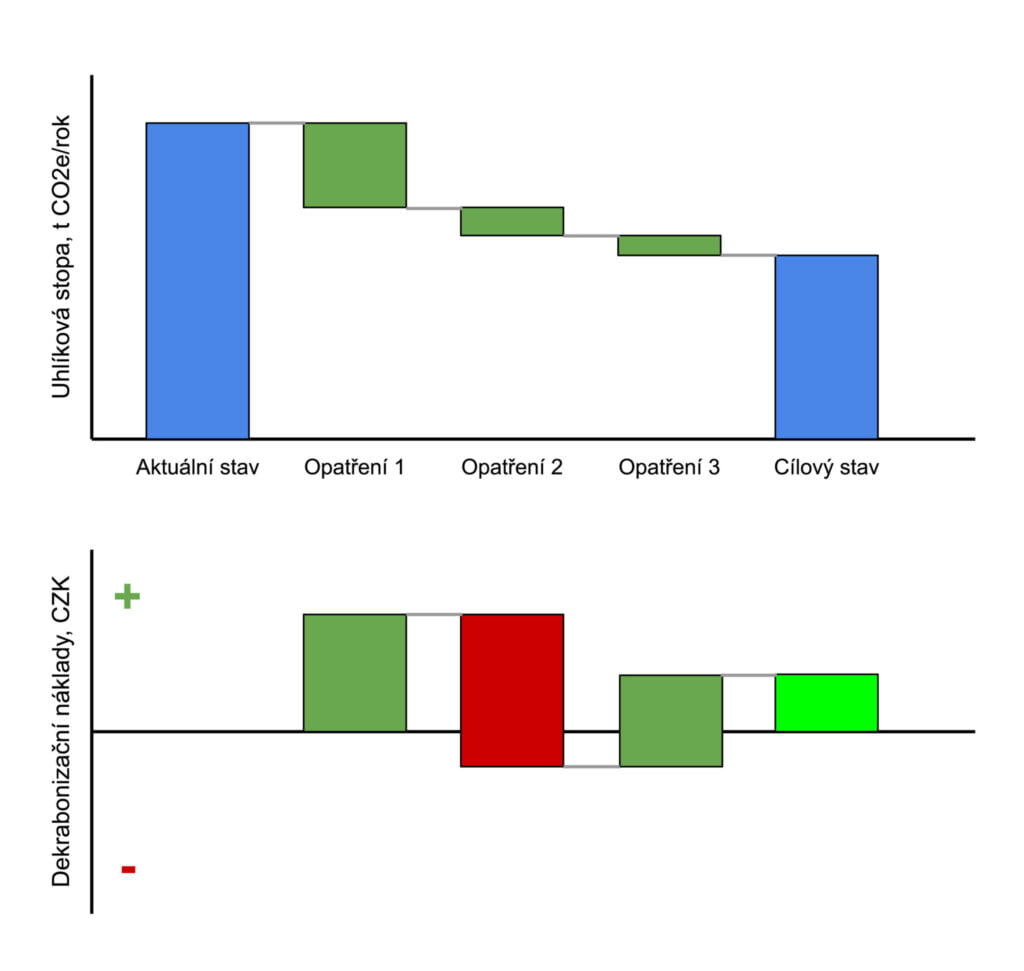
The figure shows an example of a decarbonisation strategy. The upper chart shows the current situation, three proposed decarbonisation measures and the target state. The lower chart quantifies the economics of these measures. Measures 1 and 3 bring savings, while measure 2 is a cost. Overall, however, the economics of the decarbonisation strategy are positive.
Practical examples and recommendations for carbon footprint calculation
- A carbon footprint is just a number without wider context. Ask for a complete report in line with technical standards from a company with practical experience.
- An experienced consultant will find the information needed for a carbon footprint calculation in reports that already exist. For example, disclosure requirement E5-5 includes a section on waste reporting, which is simple for manufacturers because all the information needed is in their ISPOP reports (the Czech integrated environmental reporting system), which companies already have to prepare.
- The hardest data to obtain tends to come from seemingly trivial areas, such as employee business travel or commuting.
- Find out about certification options and avoid “all-in-one” offers. The same company must not both calculate and certify.
- If your company is subject to CSRD reporting, focus on all the indicators tracked under ESG. This will save you considerable resources in the future.
- Assess your carbon footprint comprehensively, in the context of production, energy and other ESG categories. Assess the entire life cycle.
- Remember that the aim of ESG is to help reduce your company’s negative impact on nature and society.