
Corporate decarbonisation is a term we have been hearing from every side in recent years. Some see it as a necessary evil, others as a huge opportunity. The truth lies somewhere in between – and above all in practice. That is exactly where companies often start to struggle.
What really makes sense? Where do you start? And how do you avoid getting carried away by technology that ultimately solves nothing?
Corporate decarbonisation in practice: how to really get started without hitting a dead end
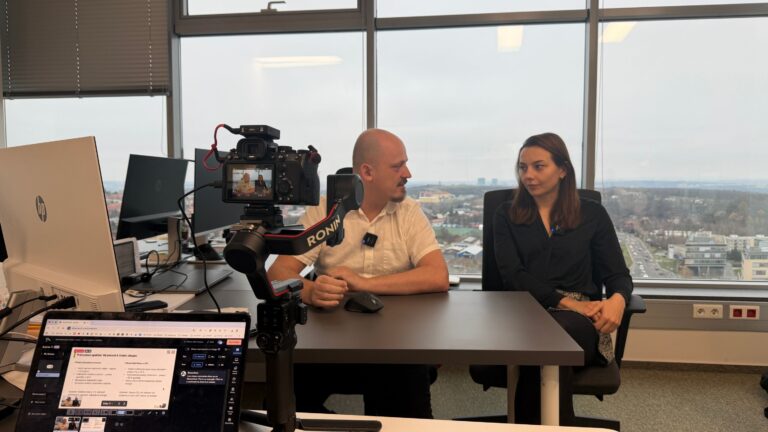
At EnviTrail, we deal with these questions every day, and that is what our webinar Corporate decarbonisation in practice – between ambition and reality was about. Below is a summary of the key points.
Decarbonisation is not about feelings. It is about data.
The most important rule: without data, you cannot make good decisions.
A properly calculated carbon footprint is not a bureaucratic document but a guide to where the real potential for savings and emission reductions lies.
When a company finds out that 70% of its carbon footprint comes from heat consumption or transport, it is immediately clear where to focus.
Without that, decarbonisation turns into random investment – and nobody wants that.
Energy savings – the cheapest and fastest step
Yes, it sounds boring.
Yes, it matters.
Energy savings are often the largest and cheapest part of decarbonisation:
optimising equipment settings,
modern controls,
replacing outdated lighting,
better operational planning.
In practice, this often cuts consumption by 10–30% without major investment. And above all, every kWh saved is a kWh you do not have to electrify or cover with solar PV.
Electrification: a good servant but a bad master
Electrification is one of the biggest trends in corporate decarbonisation today.
But it is not always right for every process.
When it makes sense:
where you already use efficient technology,
where operations are stable,
where you know what your energy demand will look like in 5–10 years.
And when to be careful?
when electrification requires a huge increase in grid connection capacity,
when the investment does not pay back,
when the main reason is just “to be modern”.
Renewables – yes, but smartly
Solar PV is now a core part of corporate strategies. But for it to work properly, you need to:
design it around actual consumption, not around available roof space,
look at future scenarios,
combine it with other steps: savings, storage, electrification.
Every percentage point of savings increases the efficiency of the renewables investment. And every badly designed PV system is a source of frustration.
Prioritisation: what to do first and what can wait
Corporate decarbonisation will not be done in a year. But with good prioritisation, it can deliver quick results.
How to order the steps:
Savings and operational optimisation (quick payback, big impact)
Electrification and modernisation of technology
Renewable energy sources
Long-term strategic investments (2030+)
The right order means money saved, lower risks and greater stability.
Case studies: what worked best
From the projects we have carried out, the most successful were:
savings of 15–25% just from better consumption management,
heating upgrades with a payback of 3–6 years,
solar PV designed around the actual consumption curve,
a combination of savings + PV + electrification → emission reductions of 40–70%.
It is about smart steps, not magic solutions.
Corporate decarbonisation is a long road. But you can start right away.
Decarbonising a company is not a one-off investment. It is a process that makes sense – if it is done properly, with data, priorities and a realistic view of operations.