

Only a year ago, fewer than a third of small and medium-sized companies were familiar with the term ESG. Today the situation is different. As suppliers to multinationals, many of them feel pressure to provide more detailed information on sustainability, even though they are not (yet) required to. They increasingly face the same pressure from customers, banks and employees who prefer responsible companies. How can you prepare for the requirements of key stakeholders and find a path to sustainability that makes economic sense?
Only a year ago, seven out of ten small and medium-sized companies with fewer than 250 employees had never heard of ESG. Awareness has improved since then, but the term is still surrounded by a lot of confusion. Comments such as ‘it will hurt our business’, ‘yet another tiresome obligation’ or ‘someone is going to assess us again’ are heard far too often in the business world.
An Ipsos survey for the Association of Small and Medium-Sized Enterprises and Crafts of the Czech Republic looked at the attitudes of SMEs to ESG. Among other things, the results showed that a large proportion of companies address the topic at least in part, even if they use their own terms for it.
Interest in ESG consultancy among SMEs is growing
EnviTrail has carried out a number of ESG scan consultations for small and medium-sized companies that are starting to work on ESG. Their motivations vary and fall into three groups.
The first (relatively small) group consists of companies whose owners see sustainable business as fundamental to their existence, regardless of any legal obligations. They want to keep pace with others and also see business opportunities in this approach. These companies already have most of the documents and data required for ESG reporting.
A growing group is motivated by the need to answer questions about their sustainability activities ever more often and from many different directions. Here too, much of the data is already available in the company, but it is not captured systematically or linked to sustainability activities.
The third group consists of companies that usually do only the necessary minimum. Sustainability as such has not been a core topic for them so far; they are unfamiliar with the subject and, as a first step, want to learn and analyse what they need to prepare for. ESG in practice: companies are doing it, even if they call it something else
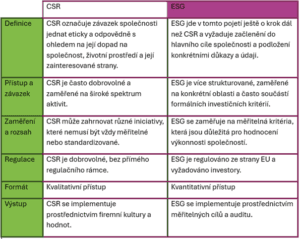
Companies often confuse ESG principles with CSR (corporate social responsibility). While CSR focuses on voluntary activities and ethical behaviour, ESG sets out specific, measurable standards that companies have to meet, for example on the environment, employee relations or governance transparency. Many small and medium-sized companies already do many of these things as a matter of course; they just call them something else.
Perhaps the most typical example is planting trees, whether on company premises (to improve the surroundings) or as a team-building activity. It is certainly a worthwhile and beneficial activity, but from an ESG perspective it is, in the vast majority of cases, insignificant on its own.
Put simply, ESG looks at corporate social responsibility from the other side. Alongside the benefit to society, it emphasises that activities should bring a clear and measurable benefit to the company itself. One example is financial literacy education in schools, in which some banks are involved. Pupils learn personal financial planning skills, which in the future gives banks responsible customers who better understand investment and lending products. In this way, banks contribute to the stability and financial responsibility of the next generation while also strengthening their ties with the community and improving their own reputation.
Many SMEs invest in renewables, electric mobility or circular economy measures. They often do so for reasons that are key to survival – savings, innovation, customer requirements – frequently without realising that they are also fulfilling ESG principles. Reporting therefore gives them a framework and focuses attention on long-term, data-based planning.
Equal treatment and safety: not just a priority but a necessity
Small and medium-sized companies place the main emphasis on social aspects such as employee health and safety, equal treatment and better working conditions. Here, practical experience matches the survey results. Small companies often pay more attention to the working environment simply because, in smaller businesses, people know each other well and are willing to help one another. The same goes for management, who are aware of how hard it is to replace any employee.
That is why social topics are a normal part of how SMEs operate. These companies focus most on occupational health and safety. It is therefore no surprise that they emphasise creating a pleasant working environment and reject discrimination.
Energy savings as a route to a lower carbon footprint
“Our experience shows that reducing energy consumption is a major topic in response to the price rises of the past four years. Companies naturally pursue economic goals, and increasingly affordable modern technologies and technical solutions also bring environmental benefits – in general, lower costs also mean a lower impact on nature,” says Lukáš Ferkl of EnviTrail, commenting on the situation of SMEs.
Energy savings contribute directly to a lower carbon footprint: the less energy a company consumes, the less carbon dioxide is emitted. This matters particularly for ESG reporting, where the corporate carbon footprint is a key metric. For SMEs (as well as for companies with fewer than 750 employees that are required to report on ESG), the basis is a calculation covering at least Scope 1 and Scope 2 – that is, direct emissions from burning carbon-based fuels and indirect emissions from purchased energy (the categories a company can influence). And it is not just about the current figure. What matters is demonstrating that emissions are falling over time. Given the ‘decarbonisation’ investments already made, companies should choose the right base year so that they can report effectively on the steps they have already taken.
How should small and medium-sized companies approach ESG?
Small and medium-sized companies with fewer than 250 employees will encounter ESG topics more and more often. At the outset, it is not always easy to identify which ESG topics to focus on. It can help to look at how large companies with reporting obligations tackle the same question. They use a process called double materiality assessment (we wrote more about double materiality here). For SMEs, a simplified version is enough, based on:
- finding out what key partners want, or will want, from the company,
- understanding why they want this information from you,
- analysing the risks and opportunities arising from the requirements identified above,
- defining strategies, metrics and targets for the selected topics,
- setting up a single reporting format for key partners.
“This process not only helps a company meet its business partners’ requirements but can also bring many useful changes. By introducing modern technologies or improving certain processes, a company can operate more efficiently, save money and even find new ways to grow its business,” explains Petr Ondráček of EnviTrail.
ESG: not just a green future but also tough decisions
One of the main reasons companies often do not put more emphasis on sustainability is uncertainty about whether ESG investments will pay off at all, along with concerns that they will not have enough money or information. In a period of turbulent change, this is entirely understandable. Companies often worry that sustainability investments will not deliver the expected benefits and will hold back further development and innovation. That is why most businesses considering ESG investments focus on reducing energy consumption.
Companies are also often put off by the administrative burden of implementing ESG. Some corporate ESG questionnaires do not take the specific situation of SMEs into account, tend to be lengthy and require detailed information. Unlike large corporations, SMEs cannot afford a team of specialists to deal with ESG in depth.
Not surprisingly, there are growing calls to simplify the process so that SMEs, which ESG reporting was never primarily aimed at, do not have to spend time and energy producing complicated reports.
How to start: the areas with the greatest impact and simple data collection
Even though SMEs do not currently have to report directly under ESG rules, their role in value chains is significant and may affect their long-term operations. Companies that realise this early can manage potential risks better and make use of the opportunities ESG brings. “To begin with, we recommend that companies focus on three main areas: identify their key environmental impacts, simplify the monitoring of energy consumption and emissions, and set up a simple data collection system,” concludes Petr Ondráček of EnviTrail. “This approach will make reporting easier in the years ahead.” A first step could be an ESG scan, which helps companies quickly identify the areas with the greatest impact on the environment and society.