

We tend to think of the carbon footprint mainly in the context of companies directly affected by the CSRD. Because the Czech Republic has committed to becoming a climate-neutral economy by 2050, individual municipalities may also become obliged to report their carbon footprint. We explain why towns and municipalities should deal with their carbon footprint, what benefits and opportunities it brings them, and where municipalities are already preparing for reporting.
The Czech Republic differs from most countries in its specific settlement structure: it has a large number of diverse municipalities and towns, each with its own problems and challenges. An individual carbon footprint calculation can flag these in time, a decarbonisation strategy can help address them better, and together they can create a system of sustainable towns. The concept of sustainable towns and municipalities includes management that takes account of advancing climate change and high-level risk management not only in environmental matters but also in social and economic ones.
“Non-financial reporting and carbon footprint tracking are currently being addressed at every level. As the regional development agency of the Hradec Králové Region, we know that companies in the region are so far only superficially prepared and informed. However, thanks to the subsidy programmes in place, we are ready to help companies in the region with this issue,” explains Jakub Semerád of the Centre for Investment, Development and Innovation.
Why the carbon footprint matters for towns and municipalities:
- growing demand for transparency in environmental protection
- new challenges in legislation and in the management of administrative units
- climate change
- sustainability is a key factor in the decisions of potential new residents
- an overview of businesses operating in the administrative area and new development opportunities
- easier preparation of an action plan and a more attractive location
- transparency is a condition for drawing subsidies, both in financing and in the municipality’s political direction
- opening up quality management in terms of the environmental opportunities and threats of individual territorial units
A municipality or town can be thought of as a unit with certain inputs and outputs: like a company, it needs energy and materials to operate. Selected areas can therefore be quantified, and it is possible to assess how much CO2 they emit.

It is not entirely clear whether the obligation to measure and report a carbon footprint will actually extend to municipalities. Given the constantly changing conditions, which the European Commission and the Council keep adjusting, it is impossible to say exactly whether this obligation will apply to municipalities. However, in view of long-term developments and global strategies, it can be considered a real possibility.
How to choose a carbon footprint methodology
For data collection, calculation and interpretation, municipalities can use the dedicated GPC methodology (The Global Protocol for Community-Scale Greenhouse Gas Emission Inventories, part of the GHG Protocol). It was developed on the basis of the Covenant of Mayors, the largest global initiative connecting city mayors to jointly reduce the greenhouse gases produced by cities. It mainly involves measuring the seven main greenhouse gases under the UN protocol: carbon dioxide (CO2), methane (CH4), nitrous oxide (N2O) and fluorinated greenhouse gases (HFCs, PFCs, SF6 and NF3), based on the internationally recognised GHG Protocol.
The choice of methodology depends on the individual needs of the town or municipality. The calculation approach and the choice of categories depend on the town’s needs, the data available and the programmes in which individual municipalities take part or plan to take part.
Although the GPC methodology, in line with the principles of the GHG Protocol, serves as guidance, it does not prescribe a single, universal methodological approach. Rather, it specifies the principles and rules that should be applied to data collection and the subsequent calculation. Everything still rests on a materiality matrix that the municipality draws up itself. Put simply, the municipality decides which areas are significant for measurement and which are not. However, we always recommend using methodologies linked to the IPCC.
The concept of scopes applies to municipalities too
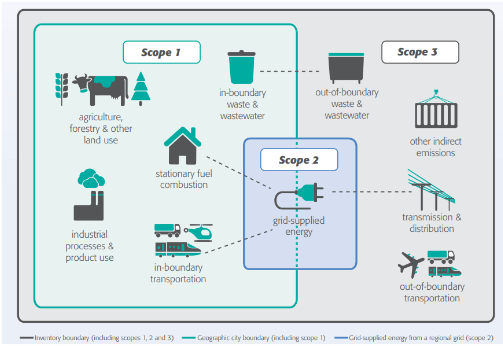
Data collection is therefore based on specific categories, which are handled slightly differently from the conventional corporate carbon footprint model. The division into scopes exists here as well, but again differs slightly. Naturally, “mandatory” and “optional” categories play a smaller role here; instead, the distinction is between a basic calculation and a comprehensive one.
We therefore recommend that municipalities start with a basic calculation, which includes fewer groups but ones with a large impact on the total carbon footprint. The infographic below shows how the groups are divided by scope.
What data should a municipality collect?
Data collection and categorisation must then be approached individually, according to each municipality’s needs. One example is a town without significant economic activity but with, say, active mineral extraction that has a negative impact on the environment. As with companies, it is essential for municipalities to start by analysing the current situation and assessing which categories will be genuinely meaningful given the activities in the town or municipality. A pilot carbon footprint calculation can set up a good process for annual data collection and for extending the tracked categories in the future. Setting up and monitoring the right categories will help define long-term environmental targets and track progress and direction over several years.
Zita Kučerová, head of the Regional Development Department of the Centre for Investment, Development and Innovation of the Hradec Králové Region, describes the projects in the region: “Our pilot project calculating the carbon footprint of municipalities currently involves 2 municipalities, known as living labs. We calculate CO2 emissions within the municipality in several categories, such as municipal operations, transport, waste and others. We draw the data mainly from public sources, or directly from the municipalities. These figures then feed into the ESG report we prepare for the pilot municipalities.”
Main benefits of calculating a carbon footprint at municipal level:
- the municipality or town is transparent and better placed to apply for subsidies or take part in competitions
- more efficient municipal operations
- an overview of the processes taking place in the area and opportunities for optimisation
- decarbonisation over the years
- the potential to reduce consumption and run institutions managed by the municipality more efficiently
- a better quality of life for residents thanks to detailed analysis
- the municipality meets its commitments under regional strategies, etc.
Main obstacles to implementation:
- cost
- time
- the heterogeneous nature of municipalities and towns and their different conditions and needs for data collection and calculation
Author: Lea Svobodová